
Explain Florida Property Laws: What You Need to Know
Confused by property laws? This guide will help you explain Florida property laws clearly, ensuring you're informed and protected in all situations.
How Florida property laws govern ownership and transfers
Understanding property laws in Florida starts with knowing how ownership is actually held. The type of ownership on your deed shapes everything from what happens…
Understanding property laws in Florida starts with knowing how ownership is actually held. The type of ownership on your deed shapes everything from what happens when a co-owner dies to whether a creditor can claim your equity.
Florida recognizes three main forms of co-ownership:
- Tenants in common: Each owner holds a separate, transferable share. One owner can sell or will their share independently. This is the default under Florida law.
- Joint tenancy with right of survivorship: When one owner dies, their share passes automatically to the surviving owner, bypassing probate entirely.
- Tenancy by the entirety: Available only to married couples. It offers creditor protection that standard joint tenancy does not.
Florida follows common law property rules, not community property. That means property you acquire during marriage is not automatically jointly owned unless the deed says so. Many couples are surprised by this.

Key Takeaways
- Homestead protection is
- Florida offers unlimited equity protection and up to
- Deed type determines your
- Warranty deeds offer title guarantees; quitclaim deeds
- Co-owners have full partition
- Any co-owner can force a sale or division of property
- Florida foreclosure requires
- Lenders must sue in court to repossess, giving owners time
How Florida property laws govern ownership and transfers: Deed types and what they mean for you
Quitclaim deeds transfer ownership without any warranties, which creates real risk if you receive one in an inheritance without verifying the title history first.
Quitclaim deeds transfer ownership without any warranties, which creates real risk if you receive one in an inheritance without verifying the title history first.
For any deed to be legally valid, two witnesses and notarization are required at signing. After that, recording rules vary by county. Miami-Dade processes recordings differently than Duval County, and fees differ too. Missing a local filing requirement can delay a sale or cloud a title for years.
Pro Tip: Before recording a deed, call your county clerk's office directly to confirm current requirements and fees. Do not rely on information from another county's website.
Documentary stamp taxes also apply to most property transfers in Florida. Sales generally carry $0.70 per $100 of the sale price, while gift deeds may still trigger taxes depending on how consideration is structured. Talk to a title company before finalizing any transfer.

Florida homestead law: protections, limitations, and probate implications
- — Creditor protection: Unlimited equity protection against most money judgments. A $1 million home can be shielded entirely from an unsatisfied court judgment.
- — Tax exemptions: Up to $50,000 in property tax exemptions as of 2026 for qualifying primary residences.
- — Protection against forced sale: Outside of very specific exceptions, no creditor can force the sale of your homestead during your lifetime.
Co-ownership rights and what happens when owners disagree
- Step 1 — Any co-owner files a partition action in circuit court under Florida Chapter 64.
- Step 2 — The court first attempts to physically divide the property if that is feasible (rare for residential property).
- Step 3 — If physical division is not practical, the court orders a sale and divides the proceeds proportionally.
- Any co-owner can force this process regardless of what percentage they own — A 5% owner can compel a 95% owner to sell.
Florida landlord-tenant laws and the foreclosure process
- — Residential tenants receive stronger statutory protections, including security deposit rules and habitability standards.
- — Commercial tenants have more flexibility to negotiate terms, but also fewer automatic protections if a landlord fails to maintain the property.
- — Month-to-month tenancies require 15 days' written notice to terminate in residential situations.
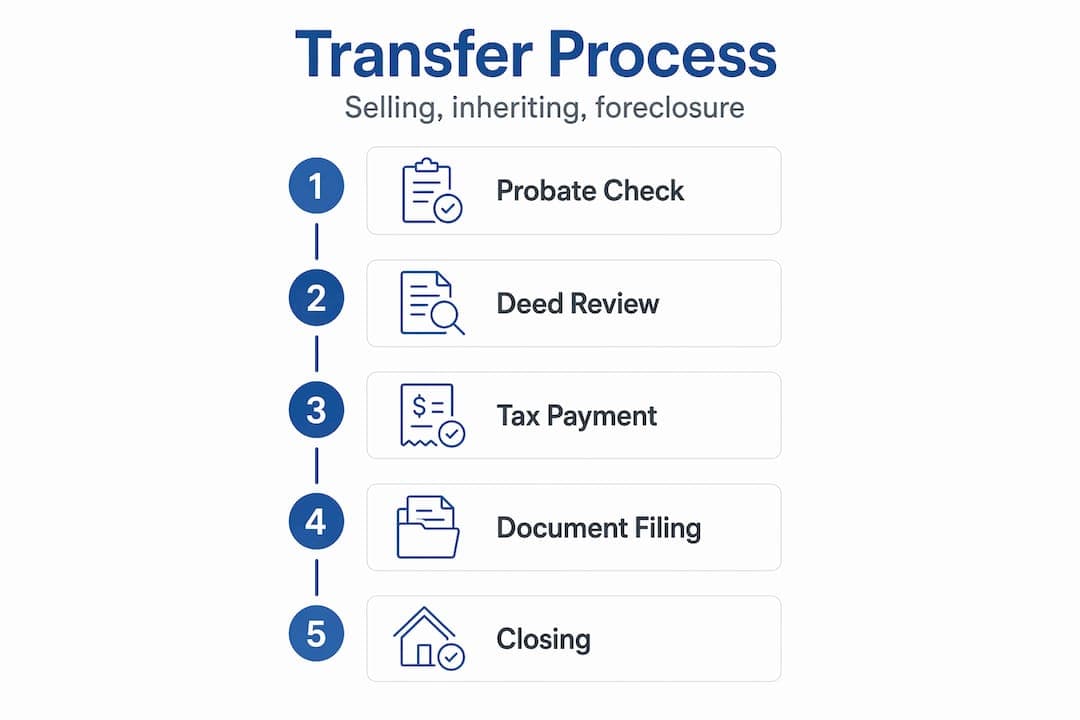
Practical steps for selling, inheriting, or facing foreclosure
- Step 1 — Confirm the deed type and verify title is clear through a title search before listing.
- Choose a title company or real estate attorney to handle closing — Florida allows either, but attorneys provide broader legal coverage.
- Step 3 — Budget for documentary stamp taxes and verify whether your transaction triggers any county-specific surcharges.
- Step 4 — Check whether the property qualifies as homestead, which affects seller tax benefits under federal capital gains rules.
- Step 5 — Learn the Florida closing process so no step catches you off guard on the day funds transfer.
My take on what most people get wrong about Florida property law
— Eric
My take on what most people get wrong about Florida property law
I have watched a lot of property decisions go sideways, not because the people involved were careless, but because they assumed one thing worked like another.
I have watched a lot of property decisions go sideways, not because the people involved were careless, but because they assumed one thing worked like another. The most costly mistake I keep seeing is treating homestead protection as a blanket shield. People hear "unlimited equity protection" and stop reading. They do not account for HOA fees, tax debts, or the restrictions on devising homestead property to heirs. Those gaps are exactly where things fall apart.
The second thing that catches people off guard is county variation. Florida real estate regulations are statewide in theory, but deed recording fees, processing timelines, and local ordinances create meaningful differences between Miami-Dade and a rural panhandle county. What worked cleanly in one transaction may stall in another county for reasons that feel arbitrary but are entirely real.
My honest advice is this: do not treat a Google search as a substitute for a title search or a real estate attorney. Understanding the framework is genuinely valuable. But the framework tells you what questions to ask, not what the answers are for your specific parcel, your specific family situation, or your specific deed history.
Property rights in Florida reward people who prepare early and penalize people who react late. Whether you are selling, inheriting, or being served papers, your best move is always the same. Get informed before the pressure forces your hand.
When the law is clear but your next step is not
Understanding property laws in Florida gives you clarity. But clarity about your legal situation does not always translate into a fast, clean path forward.
Understanding property laws in Florida gives you clarity. But clarity about your legal situation does not always translate into a fast, clean path forward. If you are holding an inherited property with title complications, receiving foreclosure notices, or simply need to sell without listing repairs, showings, and commissions, Housefastcashfl exists specifically for that situation.
Housefastcashfl provides fair cash offers within 24 hours with closings as fast as four days, regardless of property condition or legal complexity. If you want to understand whether home buying companies are legitimate before committing, that answer is right there on their site. When you are ready to move forward, you can request a no-obligation offer directly at Housefastcashfl. No repairs, no agent commissions, no waiting.
Side-by-side comparison
| What It Guarantees | Common Use | |
|---|---|---|
| Warranty deed | Full title protection against past claims | Standard property sales |
| Quitclaim deed | No guarantees whatsoever | Family transfers, divorces |
| Lady Bird deed | Transfer on death without probate | Estate planning |
Free Cash Offer
Ready to sell your house for cash?
Tell us about your property. We'll come back within 24 hours with a fair, no-obligation cash offer — no commissions, no inspection drama, no closing-cost surprises.
- Licensed Florida cash buyer
- Close in 7-21 days, on your timeline
- Free, no-obligation cash offer
- We respond within 24 hours
Cash Buyers Network
Sources & References
External sources cited in this article. Verify current figures and rules directly with the issuing source — Florida real-estate data and program rules change quarterly.
From the Blog
Continue Reading
home-selling
Inheritance Property Options: Your 2026 Heir's Guide
Explore inheritance property options in 2026: sell, rent, or move in. Learn how each choice impacts your finances and tax obligations.
Read articlehome-selling
Pitfalls of Listing Inherited Homes: 2026 Guide
Discover the pitfalls of listing inherited homes in 2026. Learn key strategies to navigate probate and safeguard your estate's value.
Read articlehome-selling
Seller Financing Rental Property in Florida: 2026 Guide
Discover how seller financing rental property in Florida can unlock investment opportunities. Learn the benefits, requirements, and legal steps.
Read articlehome-selling
Role of Heirs in Property Sales: 2026 Guide
Discover the role of heirs in property sales. Learn when you can sell inherited property and avoid common probate mistakes.
Read articleFrequently Asked
Common Questions
What does homestead protection actually cover in Florida?
+
Florida homestead law provides unlimited equity protection against most unsecured creditors and up to $50,000 in property tax exemptions for qualifying primary residences. It does not protect against mortgages, tax liens, or HOA assessments.
What is the default ownership type when multiple people own Florida property?
+
Florida law presumes tenancy in common when multiple owners hold title without specifying another arrangement, meaning each person owns a separate, transferable share that can be sold or inherited independently.
How long does Florida foreclosure take?
+
Because Florida uses judicial foreclosure requiring lenders to sue in court, the process typically takes 6 to 18 months from filing, which gives homeowners time to explore alternatives including a pre-foreclosure sale.
Can a landlord verbally notify a tenant of eviction in Florida?
+
No. Florida landlord-tenant law requires all notices to be in writing and delivered by hand, mail, or email. A verbal notice has no legal standing and does not start the eviction timeline.
Does putting your home in an LLC affect homestead protection in Florida?
+
Yes, significantly. Transferring your Florida home into an LLC removes homestead protection entirely. Certain trust structures can preserve the protection, but an LLC cannot, so ownership restructuring requires careful legal planning.