
What Is a Fair Market Offer for Your Home?
Wondering what is a fair market offer for your home? Discover insights on pricing dynamics, distressed sales, and how to empower your decisions.
What is a fair market offer in real estate
- — Assessed value: Determined by a county tax assessor for property tax purposes. It often lags behind actual market conditions and is not a reliable proxy for fair market pricing.
- — Appraised value: A licensed appraiser's professional opinion of value, typically required for mortgage financing. It draws from comparable sales but reflects a specific point in time.
- — Listing price: What a seller asks for, which can be aspirational, strategic, or simply uninformed. It is not synonymous with FMV.
- — Fair market offer: The actual dollar amount a real buyer is willing to pay under normal, unpressured market conditions.
Key Takeaways
- FMV is a range, not a number
- Fair market value shifts with comparable sales, conditions
- Distressed sales change the
- Urgency breaks the "no pressure" assumption behind FMV, so
- CMA and appraisals are your
- Use comparative market analysis and appraisal data together
- Ask for data to back low
- Legitimate buyers can justify discounted prices with comps
Key factors that shape your home's fair market offer
FMV cannot be calculated by a single fixed formula. It's an estimate grounded in comparable sales data and adjusted for real conditions.
FMV cannot be calculated by a single fixed formula. It's an estimate grounded in comparable sales data and adjusted for real conditions. Several forces push that estimate up or down.
Market type is the first lever. Seller's markets push offer prices higher because multiple buyers compete for limited inventory, sometimes triggering bidding wars that carry prices well above asking. Buyer's markets flip this dynamic. Supply outnumbers demand, giving buyers room to offer below the listing price without losing the property.
Property condition matters in direct, calculable ways. A roof that needs replacing, outdated electrical, or significant deferred maintenance all reduce what a buyer will reasonably pay. These aren't negotiating tactics; they're cost offsets reflecting what a buyer will spend after closing.
Comparable sales, or "comps," form the backbone of any fair price assessment. Comps are recent sales of similar properties within close geographic proximity, typically within a half mile and sold within the last 90 days. The closer the match in square footage, bedroom count, lot size, and condition, the more reliable the data.
Timing affects value in ways that surprise people. Seasonal patterns influence buyer activity. Spring and early summer typically bring more active buyers in Florida markets. Knowledge of neighborhood trends and quick response can genuinely affect offer success and how fair a deal feels to both parties.
Pro Tip: Before you accept or reject any offer, pull the last three to five closed sales within a quarter mile of your property. Your county property appraiser's website publishes this data publicly, and it takes under ten minutes to check. That ten minutes of research may save you from leaving money on the table or walking away from a genuinely reasonable deal.

How urgency changes what a fair offer looks like
This is the part most sellers don't want to hear, but it's the part you most need to understand. FMV assumes no compulsion.
This is the part most sellers don't want to hear, but it's the part you most need to understand.
FMV assumes no compulsion. Both parties are supposed to be acting freely, with full information and no timeline pressure. Distressed sales break that assumption, and when the assumption breaks, the resulting price typically lands below what you'd get on an unpressured open market. That is not inherently unfair. It reflects the reality of what's being exchanged.
When you need to sell in two weeks instead of two months, a buyer absorbs real risk. They're moving fast, potentially bypassing inspections, buying as-is, and committing capital without the comfort of a longer due diligence period. That risk is priced into the offer.
The table below illustrates how the same property can receive meaningfully different offers depending on selling circumstances:
The gap between standard FMV and a distressed offer is not a scam. It is the cost of speed, certainty, and convenience. If you're facing a situation where quick sale dynamics matter, knowing this range in advance protects you from panic rejecting a fair deal or accepting one that's genuinely below market.
Pro Tip: Get a standard FMV estimate first using a CMA or appraisal, then apply a realistic adjustment for your timeline and property condition. That gives you a floor. Any offer above that floor deserves serious consideration. Anything significantly below it deserves a conversation and documentation.
How to determine a fair market offer for your property
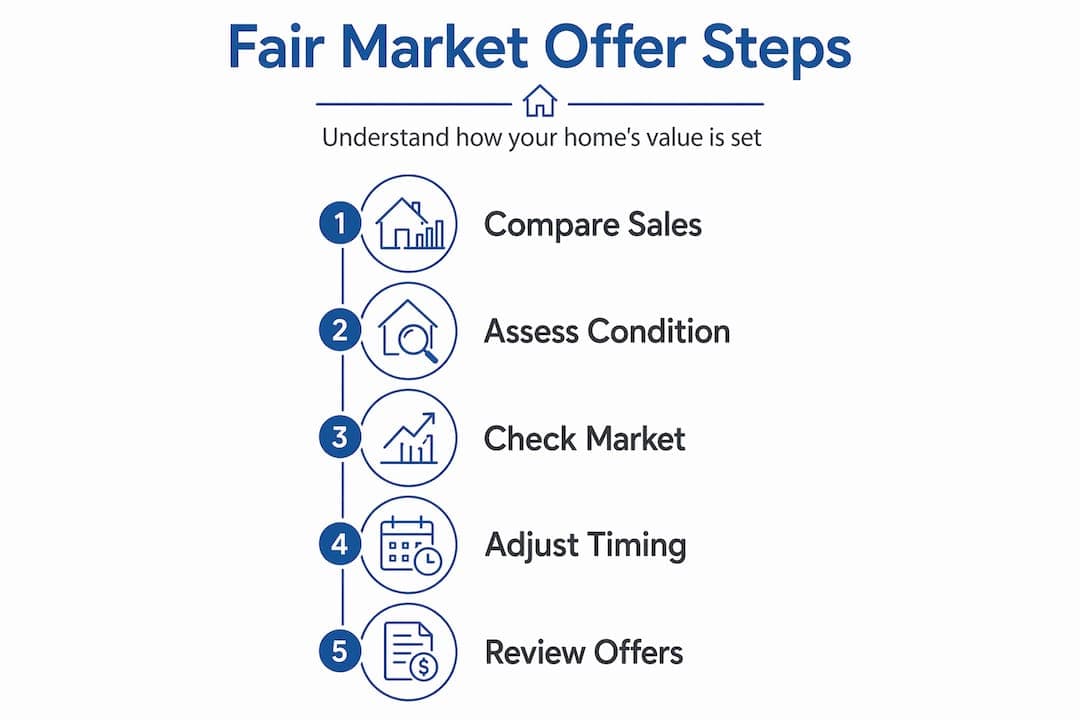
- Step 1 — Commission a Comparative Market Analysis (CMA). A licensed real estate agent will pull recent comparable sales, active listings, and expired listings to produce a detailed value range Many agents provide these at no charge. A CMA is the most practical starting point for understanding fair market value offer guidelines.
- Step 2 — Order a formal appraisal. Appraisals help determine value but are distinct from FMV in that they reflect one appraiser's professional judgment at a specific moment Appraisals typically cost $300 to $600, but they carry significant weight when evaluating or challenging a buyer's offer.
- Step 3 — Calculate price per square foot benchmarks. Divide recent sale prices of comparable homes by their square footage If similar homes in your neighborhood sold for $195 to $215 per square foot, use that range to sanity-check any offer you receive. A cash offer at $150 per square foot on a property in solid condition deserves scrutiny.
- Step 4 — Use your county property appraiser's database. In Florida, every property sale becomes part of the public record You can search your neighborhood for closed sales, filter by date and property type, and build your own comp list without relying on anyone else.
- Get more than one offer. This is what is a property valuation in practice — The market tells you what something is worth when multiple buyers are willing to name a number. Even if you're selling urgently, getting two or three cash offers gives you real comparison data instead of a single number to weigh in isolation.
Responding to offers wisely under pressure
- — Accepting the first number without comparison. Even one additional offer changes your negotiating position entirely.
- — Focusing only on the gross price. Net proceeds after costs matter more than the headline number.
- — Letting emotion override data. Offers 10 to 20% below asking can reflect legitimate repair costs or market conditions, not bad faith.
- — Assuming speed always means a bad deal. Some of the fairest offers come from buyers who can close fast and have the data to justify their price.
- — Ignoring contingencies. A higher offer loaded with repair contingencies, financing conditions, and extended closing timelines may deliver less certainty than a lower clean cash offer.
My take on fair offers and seller expectations
— Eric
My take on fair offers and seller expectations
I've worked alongside homeowners in some genuinely difficult situations, and the pattern I see most often is not sellers getting cheated.
I've worked alongside homeowners in some genuinely difficult situations, and the pattern I see most often is not sellers getting cheated. It's sellers entering negotiations without a baseline.
When you don't know your FMV range before the conversation starts, every offer feels like a guess. You're negotiating against a number in your head that may or may not reflect reality. The seller who knows their unpressured FMV is $350,000, understands their as-is condition shaves $30,000 off that, and needs to close in three weeks is in a completely different position than one who just hopes for the best.
What I've found genuinely useful is treating FMV as a range, not a verdict. The market doesn't hand you a certificate of value. It hands you a zone, shaped by comps, condition, timing, and buyer motivation. Understanding that zone is the difference between feeling exploited by a $305,000 cash offer and recognizing it as a reasonable price for certainty and speed.
The sellers I've seen come out ahead emotionally and financially are the ones who separate what their home means to them from what the market will pay for it. That separation is not cold. It's protective. It keeps you from holding out for a number the market simply isn't willing to deliver.
How Housefastcashfl can help you get a fair cash offer fast
If you're a Florida homeowner facing a tight timeline, Housefastcashfl exists precisely for this situation.
If you're a Florida homeowner facing a tight timeline, Housefastcashfl exists precisely for this situation. Whether you're dealing with foreclosure, an inherited property, significant repairs, or simply need to move on without the months-long process of a traditional listing, the team at Housefastcashfl provides no-obligation cash offers within 24 hours.
Housefastcashfl is verified as legitimate through Google and BBB listings, and every offer is backed by local Florida market data. There are no commissions, no repair requirements, and no showings to organize. Closing timelines can be as short as four days. If you want to know exactly where your property stands before making any decision, start with a free home evaluation and get a real number to work from.
At-a-glance comparison
Standard market listing — Estimated FMV: $350,000 · Realistic Offer Range: $340,000 to $365,000 · Key Factor: Normal buyer competition **Property…
Standard market listing — Estimated FMV: $350,000 · Realistic Offer Range: $340,000 to $365,000 · Key Factor: Normal buyer competition
Property needs significant repairs — Estimated FMV: $350,000 · Realistic Offer Range: $290,000 to $315,000 · Key Factor: Repair cost offset
Foreclosure timeline pressure — Estimated FMV: $350,000 · Realistic Offer Range: $280,000 to $305,000 · Key Factor: Speed and risk premium
Inherited property, out of state — Estimated FMV: $350,000 · Realistic Offer Range: $295,000 to $320,000 · Key Factor: Carrying cost and convenience
Cash buyer, fast close, as-is — Estimated FMV: $350,000 · Realistic Offer Range: $300,000 to $325,000 · Key Factor: Certainty and speed tradeoff

Free Cash Offer
Ready to sell your house for cash?
Tell us about your property. We'll come back within 24 hours with a fair, no-obligation cash offer — no commissions, no inspection drama, no closing-cost surprises.
- Licensed Florida cash buyer
- Close in 7-21 days, on your timeline
- Free, no-obligation cash offer
- We respond within 24 hours
Cash Buyers Network
Sources & References
External sources cited in this article. Verify current figures and rules directly with the issuing source — Florida real-estate data and program rules change quarterly.
From the Blog
Continue Reading
home-selling
Inheritance Property Options: Your 2026 Heir's Guide
Explore inheritance property options in 2026: sell, rent, or move in. Learn how each choice impacts your finances and tax obligations.
Read articlehome-selling
Pitfalls of Listing Inherited Homes: 2026 Guide
Discover the pitfalls of listing inherited homes in 2026. Learn key strategies to navigate probate and safeguard your estate's value.
Read articlehome-selling
Seller Financing Rental Property in Florida: 2026 Guide
Discover how seller financing rental property in Florida can unlock investment opportunities. Learn the benefits, requirements, and legal steps.
Read articlehome-selling
Role of Heirs in Property Sales: 2026 Guide
Discover the role of heirs in property sales. Learn when you can sell inherited property and avoid common probate mistakes.
Read articleFrequently Asked
Common Questions
What is a fair market offer in real estate?
+
A fair market offer is a price a knowledgeable, willing buyer would pay a knowledgeable, willing seller under normal market conditions without either party being under pressure or compulsion.
How is fair market value different from appraised value?
+
Fair market value reflects what the open market would pay based on comparable sales and current conditions. An appraised value is one licensed professional's point-in-time opinion, which is used primarily for mortgage lending purposes.
Why are cash offers for distressed properties lower than FMV?
+
Distressed sales typically receive lower offers because the speed and as-is nature transfer risk to the buyer, who prices that risk into the offer. The gap reflects real costs including repair uncertainty and compressed due diligence timelines.
How can I tell if an offer I received is fair?
+
Run a comparative market analysis or check your county's public property sales records to establish a FMV range. Then adjust for your property's condition, your timeline, and the buyer's terms. A fair offer sits within a reasonable band below unpressured FMV.
Should I always negotiate a low offer?
+
Not automatically. Context matters significantly, and an offer 10 to 20% below your listing price may fully reflect documented repair costs or current market conditions rather than a bad-faith attempt to underpay.