Step-By-Step Cash Home Sale Workflow for Florida Homeowners
Discover a step-by-step cash home sale workflow for Florida homeowners. Avoid pitfalls and close confidently with our expert guide!
What actually happens in a cash home sale workflow?
- Seller: You, providing documents, disclosures, and signatures
- Cash buyer: The investor or company purchasing the property outright
- — Title company or real estate attorney: Conducts the title search, holds escrow, and prepares closing documents
- Closing agent: Coordinates the final paperwork and funds transfer
Key Takeaways
- Title is the key bottleneck
- Clearing title issues like liens and probate is what
- Preparation prevents delays
- Gathering all necessary documents and resolving title or
- Sell as-is, but disclose
- Even as-is cash sales require honest disclosure and may
- Special cases need extra steps
- Inherited homes and foreclosures in Florida add unique
Prepping for a rapid cash sale: What to gather and check
- Government-issued photo ID (passport or driver's license)
- Current deed showing ownership
- Recent property tax statements
- HOA governing documents and contact information (if applicable)
- Mortgage payoff statement from your lender
Executing the sale: Step-by-step from offer to closing
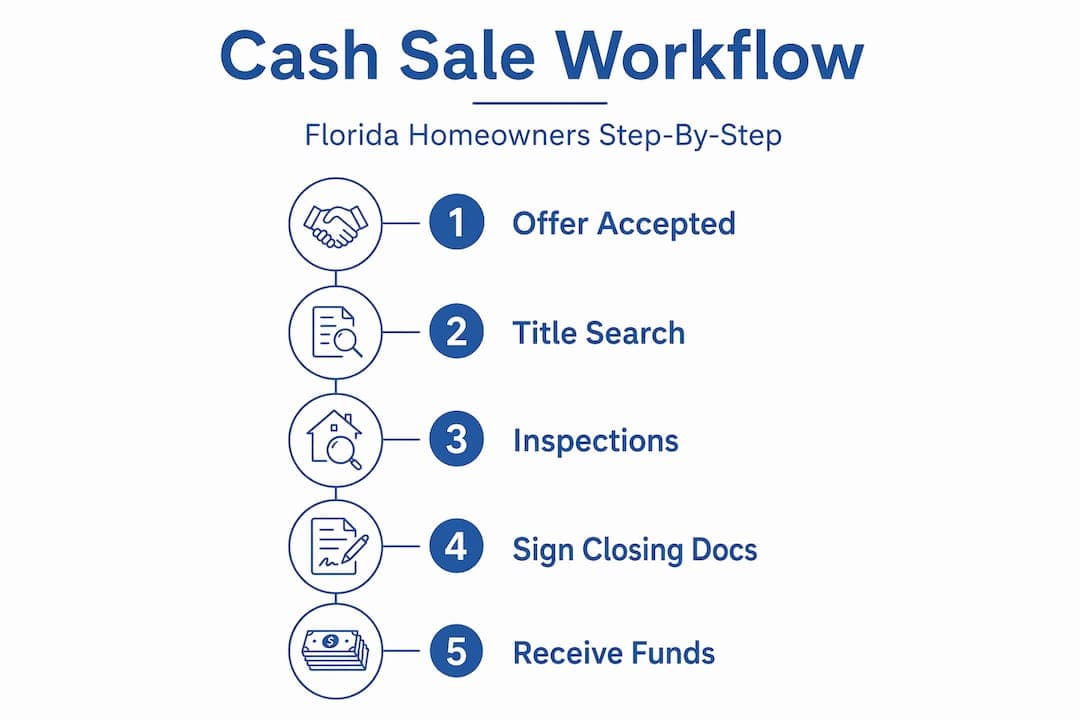
- Step 1 — Request and receive a cash offer. Reputable buyers typically provide a written offer within 24 hours of reviewing your property details Review it carefully, including the purchase price, any contingencies, and the proposed closing date.
- Step 2 — Sign the purchase and sale agreement. This legally binding contract spells out the terms Review it for inspection contingencies, closing costs, and what happens if either party backs out. Contract contingencies matter even in faster deals. Contract terms determine whether a buyer can back out or demand renegotiation, so read every clause.
- Step 3 — Complete seller disclosures. Florida law requires sellers to disclose all known material defects This step is not optional, even in as-is cash transactions.
- Step 4 — Buyer conducts inspection (if included). Even when selling as-is, buyers often reserve the right to inspect In as-is investor transactions, inspections may be limited, but sellers must still make disclosures and buyers can inspect. The good news is that most cash buyers are not looking for an excuse to walk away. They price risk into their offer.
- Step 5 — Title company opens escrow and begins title search. This is where preparation pays off A clean title can be confirmed in roughly 48 hours. A clouded title, one with liens, unpermitted work, or probate complications, requires additional legal work before closing can proceed.
Special scenarios: Foreclosure, inheritance, and post-closing verification
- — A lis pendens (a public court notice of pending foreclosure) on title must be addressed before closing
- — Your lender's payoff amount changes daily due to accumulating interest and fees, so get an updated payoff letter right before closing
- Surplus funds are a real issue — if your home sells at auction for more than what's owed, Florida Statute 45.032 governs how those surplus funds are handled, with lienholders paid first and former owners able to claim remaining funds through a court process
- — If the property was held in a revocable living trust, probate is typically not required and you can sell much faster
- — If the property transferred through a will, Florida probate court must validate the will and issue letters testamentary before you can legally convey the title
Why fast isn't always fast: What most Florida sellers get wrong
Stepping back, many sellers miss a crucial truth about cash sales. The phrase "close in seven days" is technically possible, but only when every single document is…
Stepping back, many sellers miss a crucial truth about cash sales.
The phrase "close in seven days" is technically possible, but only when every single document is in order, the title is spotlessly clean, and all parties are available to sign on demand. In our experience working with Florida homeowners, that scenario is the exception, not the rule.
Here's the uncomfortable truth: the cash part of a cash sale takes about 30 minutes. The wire transfer, the signed deed, the disbursement of funds. That's fast. What isn't fast is the legal and title machinery that must run before those 30 minutes can happen.
The real bottleneck in most cash closings is title clearance and documentation: liens, probate or heir authority, HOA items, and municipal lien or permit searches. Not mortgage underwriting. The speed gap between a seven-day close and a thirty-day close almost always comes down to how prepared the seller was before the first offer was signed.
We've seen sellers lose weeks because they didn't know about a contractor's lien filed years ago. We've seen inherited property sales stall for months because the estate hadn't cleared probate. And we've seen foreclosure sales collapse because the seller didn't get an updated payoff amount and the numbers didn't work at the closing table.
What saves time, more than anything else, is showing up prepared. Get your title checked early. Know your payoff to the penny. Understand your probate status if you're selling an estate. Have every heir's contact information and availability confirmed before you accept an offer.
Pro Tip: Before signing a purchase agreement, always verify the true speed factors in your specific situation. A reputable cash buyer will be honest with you about what could slow things down rather than promising an unrealistic timeline to win your business.
Simplify your sale: Get a cash offer with expert support
If you're ready to take the next step or need expert help navigating these steps, here are your options.
If you're ready to take the next step or need expert help navigating these steps, here are your options.
The steps in this guide exist to protect you, not to slow you down. But navigating title issues, probate paperwork, foreclosure timelines, and lien payoffs is genuinely complex. Working with the right buyer makes all the difference between a closing that happens in days and one that drags into months.
At House Fast Cash FL, we work with Florida homeowners across every one of these situations. We understand Florida's title and legal requirements, and we bring the experience to move efficiently through even complicated scenarios involving inherited properties, foreclosure risk, or significant property damage. You can get a cash offer in 24 hours with no obligation, no commissions, and no repairs required. If you're wondering whether this kind of service is right for you, learn more about how home buying companies work and what to look for in a trustworthy buyer. You deserve clarity, not more stress.

Side-by-side comparison
| Traditional financed sale | Cash home sale | |
|---|---|---|
| Offer and acceptance | 1 to 3 days | 24 to 48 hours |
| Loan underwriting | 2 to 5 weeks | Not required |
| Appraisal | Required by lender | Usually waived |
| Title search | Required | Required |
| Inspection | Typically required | Often optional |
| Closing | 30 to 60 days | 7 to 21 days (title dependent) |
| Deed recording | After closing | After closing |
Free Cash Offer
Ready to sell your house for cash?
Tell us about your property. We'll come back within 24 hours with a fair, no-obligation cash offer — no commissions, no inspection drama, no closing-cost surprises.
- Licensed Florida cash buyer
- Close in 7-21 days, on your timeline
- Free, no-obligation cash offer
- We respond within 24 hours
Cash Buyers Network
Sources & References
External sources cited in this article. Verify current figures and rules directly with the issuing source — Florida real-estate data and program rules change quarterly.
From the Blog
Continue Reading
home-selling
Inheritance Property Options: Your 2026 Heir's Guide
Explore inheritance property options in 2026: sell, rent, or move in. Learn how each choice impacts your finances and tax obligations.
Read articlehome-selling
Pitfalls of Listing Inherited Homes: 2026 Guide
Discover the pitfalls of listing inherited homes in 2026. Learn key strategies to navigate probate and safeguard your estate's value.
Read articlehome-selling
Seller Financing Rental Property in Florida: 2026 Guide
Discover how seller financing rental property in Florida can unlock investment opportunities. Learn the benefits, requirements, and legal steps.
Read articlehome-selling
Role of Heirs in Property Sales: 2026 Guide
Discover the role of heirs in property sales. Learn when you can sell inherited property and avoid common probate mistakes.
Read articleFrequently Asked
Common Questions
How long does a cash home sale usually take in Florida?
+
A typical cash home sale may close in as little as 7 to 14 days if the title is clear, but title complications like liens or probate issues can extend the timeline significantly. A quick title search can confirm a clean title within about 48 hours, but a "cloud" forces additional legal work.
Do I have to fix problems if I sell my home as-is for cash?
+
You are generally not required to make repairs, but you must disclose all known material defects and buyers still have inspection rights even in as-is transactions. The seller isn't required to fix anything, but disclosure duties remain in full.
What happens to my mortgage or liens in a cash sale?
+
All mortgages and liens must be paid off at closing from the cash proceeds before you receive any remaining funds. Lien payoff documentation is required before the title company will issue clean title insurance, so getting payoff letters early is essential.
How does selling an inherited property for cash work in Florida?
+
If the property was held in a will, probate is typically required before sale; if a revocable living trust was used, probate can often be bypassed and the process is significantly faster. All heirs or authorized estate representatives must participate in the closing.
What does Florida law say about surplus funds after a foreclosure sale?
+
The court clerk holds surplus funds and pays lienholders first in order of priority. Any remaining amount can be claimed by former owners or heirs through a formal court claim process governed by Florida Statute 45.032.