
Role of Heirs in Property Sales: 2026 Guide
Discover the role of heirs in property sales. Learn when you can sell inherited property and avoid common probate mistakes.
What is the role of heirs in property sales?
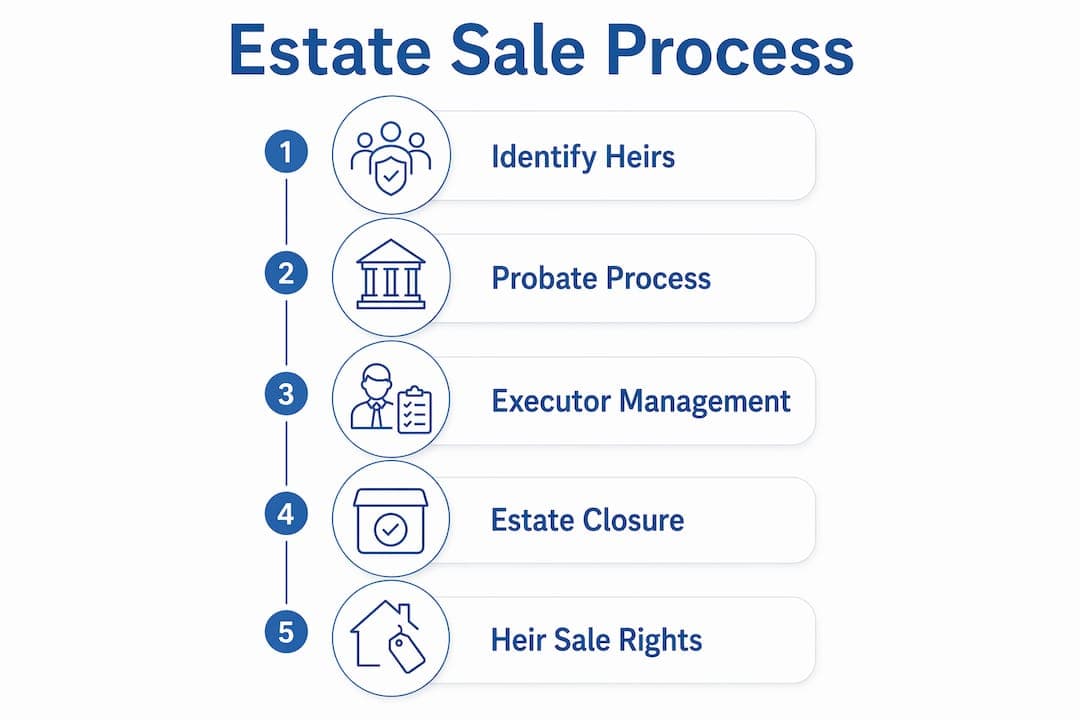
Heirs are the legal beneficiaries of an estate. Their role in a property sale depends entirely on where the estate stands in the probate process.
Heirs are the legal beneficiaries of an estate. Their role in a property sale depends entirely on where the estate stands in the probate process. Before probate closes, heirs have no independent authority to sign contracts, list the property, or authorize repairs. After probate closes, heirs become full owners and carry all the rights and responsibilities that come with that title.
The executor, also called a personal representative, holds fiduciary duties during probate to manage estate assets, coordinate sales, maintain records, and communicate with heirs. That authority is exclusive. Heirs can receive updates and provide input, but they cannot override the executor's legal control while the estate remains open.
This distinction matters because many heirs assume that being named in a will grants immediate ownership. It does not. The will names you as a beneficiary. Ownership transfers only after the court closes the estate through probate.

Key Takeaways
- Executor controls during
- Only the executor can sell or contract estate property
- Stepped-up basis reduces taxes
- The property's tax value resets to fair market value at
- Co-heirs must agree to sell
- All owners must consent; disputes can be resolved through
- Personal debts affect proceeds
- An heir's bankruptcy or judgments can redirect their share
What rights and responsibilities do heirs have after estate closure?
- — Property taxes: You owe taxes from the date of transfer. Missed payments can trigger liens that complicate or block a future sale.
- — Maintenance: Neglecting the property reduces its value and can create liability if someone is injured on the premises.
- — Disclosure obligations: Florida law requires sellers to disclose all known material defects to buyers (Florida Realtors). Inheriting a property does not exempt you from this rule.
- — Co-heir consent: If multiple heirs inherit the property together, all owners must agree to sell. One heir cannot force a sale without the others' consent or a court order.
What are the tax implications for heirs selling inherited property?
Tax planning is one of the most financially significant parts of selling inherited real estate. The good news is that heirs benefit from a stepped-up basis, which…
Tax planning is one of the most financially significant parts of selling inherited real estate. The good news is that heirs benefit from a stepped-up basis, which resets the property's tax value to its fair market value at the date of the original owner's death. That means if you sell quickly after inheriting, your capital gains tax exposure is minimal.
2026 federal long-term capital gains rates are 0%, 15%, or 20% depending on your income. These rates apply to property held for more than one year. If you sell within a year of inheriting, the gain is taxed as ordinary income, which is typically higher.
Classifying the property early as personal use, rental, or investment opens different deductions and tax treatments. Rental properties allow depreciation deductions. Investment properties may qualify for 1031 exchanges. Personal-use properties do not.
Property tax reassessment is a separate issue. California's Proposition 19 restricted parent-to-child reassessment exemptions starting in 2021, and other states have their own rules. In Florida, the homestead exemption and Save Our Homes assessment cap rules govern how inherited properties are reassessed, so local legal guidance is essential (Florida Statutes).
Pro Tip: Meet with a CPA or estate tax attorney before listing the property. The stepped-up basis calculation requires a formal appraisal dated at the time of death, and getting that number wrong can cost you thousands at closing.
What challenges arise when multiple heirs inherit one property?
- — Partition action: A court can order the property sold and proceeds divided, even over one heir's objection. Under Florida law, any co-owner of real property has the statutory right to bring a partition action to compel a sale (Florida Statutes).
- — Buyout: One heir purchases the others' shares at fair market value, becoming the sole owner.
- — Forced sale: In extreme cases, a judge orders a sale at auction to resolve the dispute.
Practical steps for heirs to complete a property sale
- Step 1 — Confirm estate status. Verify that probate is closed and that you have a deed in your name before taking any sale-related action.
- Step 2 — Order a title review. A title company will identify unresolved mortgages, liens, or ownership gaps that must be cleared before closing.
- Step 3 — Get a professional appraisal. You need a current market value for pricing and a date-of-death value for your stepped-up basis calculation.
- Step 4 — Reach a written co-heir agreement. If multiple heirs are involved, document the sale terms, price range, and proceeds split before listing.
- Step 5 — Coordinate with a probate attorney. Even after estate closure, a probate attorney can confirm your authority, review contracts, and catch issues before they become problems.
Key Takeaways
Heirs gain full authority to sell inherited property only after probate closes, making estate status the single most important factor in any inherited property transaction.
Heirs gain full authority to sell inherited property only after probate closes, making estate status the single most important factor in any inherited property transaction.

What I've learned watching heirs make the same mistakes
— Eric
What I've learned watching heirs make the same mistakes
Working in Florida real estate, I have seen the same pattern repeat itself. An heir finds out they are in the will, assumes they now own the house, and calls a real estate agent the next week.
Working in Florida real estate, I have seen the same pattern repeat itself. An heir finds out they are in the will, assumes they now own the house, and calls a real estate agent the next week. The listing goes up. A buyer makes an offer. Then the probate attorney calls to explain that the estate is still open and the contract is unenforceable. The buyer walks. The heir loses months of market time and sometimes a strong offer that will not come back.
The second most common mistake is underestimating co-heir friction. Siblings who get along fine at the funeral can become adversaries when a $400,000 asset is on the table. One wants to sell fast. One wants to wait for the market to improve. One wants to move in. Without a written agreement before listing, these conversations happen in front of buyers and agents, which signals chaos and kills deals.
My honest advice is to treat the legal steps as non-negotiable and the family conversations as equally urgent. Get the estate closed on paper. Get the co-heir agreement in writing. Then sell. The heirs who follow that sequence close faster, net more, and fight less. The ones who skip steps spend the difference on attorneys.
For heirs who want to understand the full financial picture before deciding, the guide on why heirs choose to sell lays out the most common motivations and financial trade-offs clearly.
Housefastcashfl works with heirs on inherited property sales
Inherited properties come with legal complexity, family dynamics, and time pressure that standard real estate transactions do not.
Inherited properties come with legal complexity, family dynamics, and time pressure that standard real estate transactions do not. Housefastcashfl specializes in exactly these situations across Florida.
Housefastcashfl provides fair, no-obligation cash offers within 24 hours, with closing timelines as short as four days. The process works whether the estate is freshly closed, the property needs repairs, or co-heirs simply want a fast, clean exit. There are no commissions, no showings, and no waiting on buyer financing. If you are ready to move forward, you can get a cash offer today. You can also learn more about working with Florida cash buyers and what makes a buyer legitimate before you commit to anything.
Side-by-side comparison
| Tax Treatment | Key Consideration | |
|---|---|---|
| Sell shortly after inheriting | Stepped-up basis minimizes gain | Most tax-efficient timing |
| Hold over one year | Long-term capital gains rates apply | 0%, 15%, or 20% by income |
| Rent the property | Depreciation deductions available | Different classification rules apply |
| Personal use | No depreciation; capital gains on sale | Consult a tax advisor |
Free Cash Offer
Ready to sell your house for cash?
Tell us about your property. We'll come back within 24 hours with a fair, no-obligation cash offer — no commissions, no inspection drama, no closing-cost surprises.
- Licensed Florida cash buyer
- Close in 7-21 days, on your timeline
- Free, no-obligation cash offer
- We respond within 24 hours
Cash Buyers Network
Sources & References
External sources cited in this article. Verify current figures and rules directly with the issuing source — Florida real-estate data and program rules change quarterly.
From the Blog
Continue Reading
home-selling
Inheritance Property Options: Your 2026 Heir's Guide
Explore inheritance property options in 2026: sell, rent, or move in. Learn how each choice impacts your finances and tax obligations.
Read articlehome-selling
Pitfalls of Listing Inherited Homes: 2026 Guide
Discover the pitfalls of listing inherited homes in 2026. Learn key strategies to navigate probate and safeguard your estate's value.
Read articlehome-selling
Seller Financing Rental Property in Florida: 2026 Guide
Discover how seller financing rental property in Florida can unlock investment opportunities. Learn the benefits, requirements, and legal steps.
Read articlehome-selling
House Selling Timeline in 2026: What to Expect
Discover the key steps to explain house selling timeline 2026. Learn how to prepare and navigate the process for a successful sale.
Read articleFrequently Asked
Common Questions
What is the role of heirs in property sales?
+
Heirs have no authority to sell inherited property during probate. Full ownership and sale rights transfer only after the estate closes and a deed is issued in the heir's name.
Can an heir sell a property before probate is complete?
+
No. Only the executor holds legal authority to sell estate property during probate. An heir who signs a contract without that authority creates an unenforceable agreement.
Do all heirs have to agree to sell inherited property?
+
Yes, in most cases. All co-owners must consent to a sale unless a court orders a partition or forced sale to resolve a dispute.
How does the stepped-up basis reduce taxes for heirs?
+
The stepped-up basis resets the property's tax value to its fair market value at the date of the original owner's death. Heirs who sell quickly after inheriting typically owe little or no capital gains tax.
What happens if one heir has personal debts when the property sells?
+
Closing agents can redirect that heir's share of the proceeds to creditors or court accounts. This does not block the sale but can delay payments to other co-heirs at closing.