
Step by Step Property Selling: Your 2026 Guide
Master step by step property selling with our 2026 guide! Avoid costly mistakes when selling your home, whether in foreclosure or not.
What does step by step property selling actually involve?
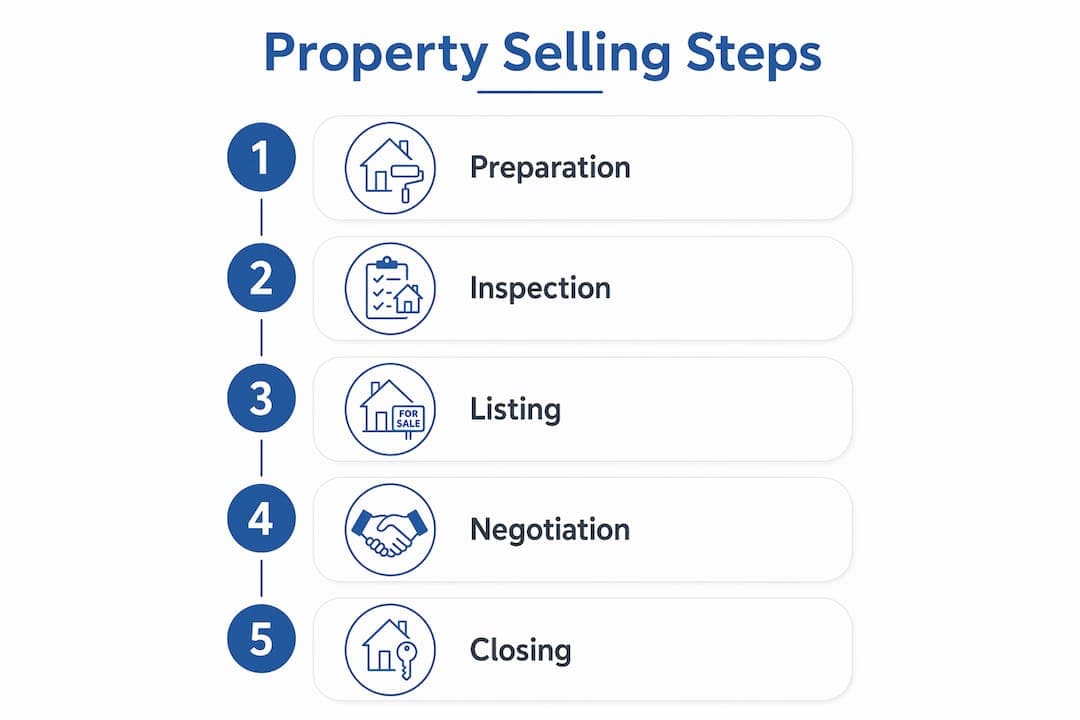
The full property sale process covers inspection, repairs, staging, listing, negotiating, appraisal, and closing with title or attorney assistance.
The full property sale process covers inspection, repairs, staging, listing, negotiating, appraisal, and closing with title or attorney assistance. Each stage feeds the next, and skipping one creates problems two steps later. A seller who lists without a pre-listing inspection, for example, hands the buyer all the negotiating leverage once the buyer's inspector finds issues.
Your situation shapes how you move through these stages. A homeowner with a clean title, no mortgage pressure, and a move-in-ready property can take 60 to 90 days and optimize for price. A homeowner with a foreclosure notice, a probate dispute, or a property that needs a new roof is working against a clock, and the process must be front-loaded and compressed accordingly.
Key Takeaways
- Title search
- Title company confirms no liens, judgments, or ownership
- Settlement statement review
- Both parties review the HUD-1 or ALTA statement showing all
- Document signing
- Seller signs the deed, transfer documents, and any lender
- Fund disbursement
- Title company or attorney releases proceeds to seller after
How to prepare your home and documents for sale
Preparation is where most sellers either gain control or lose it. The decisions you make here determine your negotiating position for the rest of the sale.
Preparation is where most sellers either gain control or lose it. The decisions you make here determine your negotiating position for the rest of the sale.
How to prepare your home and documents for sale: Inspection, repairs, and the as-is decision
A pre-listing inspection gives you control over condition disclosure and negotiation strength…
A pre-listing inspection gives you control over condition disclosure and negotiation strength before a buyer's inspector does the same job with the buyer's interests in mind. You learn what needs fixing, what can be disclosed and priced around, and whether a full repair program makes financial sense. Major repairs often cost more than they add to the sale price, particularly in distressed properties. Sellers who skip this step frequently face renegotiation or deal collapse after the buyer's inspection.
For a step by step selling neglected home scenario, the as-is route is often the right call. You disclose known defects, price accordingly, and target buyers who expect a project.
How to prepare your home and documents for sale: Documents every seller needs to gather
- Title deed and mortgage payoff statement from your lender
- Property disclosure forms required by Florida law
- HOA documents if applicable, including bylaws and fee schedules
- Recent utility bills and tax records to support buyer due diligence
- Survey and permit history for any additions or improvements
How to prepare your home and documents for sale: Special preparation for foreclosure sellers
Foreclosure timing is absolute: the sale must close before the foreclosure…
Foreclosure timing is absolute: the sale must close before the foreclosure auction date, or ownership transfers immediately and you lose all equity. Contact your lender the moment you decide to sell. Request the exact auction date, ask about a forbearance or short sale approval if needed, and get your payoff figure in writing. Front-loading your documents and disclosures is not optional here. It is the difference between closing in time and losing the property.

How to prepare your home and documents for sale: Special preparation for probate sellers
In probate sales, legal authority must be established before the sale can legally complete.
In probate sales, legal authority must be established before the sale can legally complete. You can market the property and accept offers before receiving the Grant of Probate or Letters of Administration, but no transaction can close without it. Inform your real estate attorney and any buyers upfront about this timeline. Contracts in probate sales are typically written as conditional on grant receipt, with completion deferred until the legal authority is confirmed.
Pro Tip: If you are selling under probate, ask your attorney for a realistic grant timeline before you accept any offer. Buyers who are not prepared to wait will walk, and you will waste weeks.
How to price your property competitively and strategically
- Step 1 — Run a comparative market analysis (CMA). A CMA compares your property to recently sold homes of similar size, condition, and location Your real estate agent or a licensed appraiser can produce one. For distressed properties, compare only to other distressed or as-is sales, not to renovated homes.
- Step 2 — Price to condition. A property needing $40,000 in repairs should not be priced as if those repairs are complete Buyers will discount it anyway, and overpricing just delays the inevitable while burning time you may not have.
- Step 3 — Account for urgency. As-is cash sales can close in 7 to 21 days, which has real financial value when you are facing a foreclosure auction or a probate dispute That speed is worth a price concession compared to a traditional 60-day listing.
- Step 4 — Get a second opinion. If your agent's CMA and an independent appraiser's value differ by more than 5%, understand why before you set your list price Appraisers are bound by USPAP standards; agents are working from market data. Both perspectives matter.
- Step 5 — Revisit pricing every 14 days. If you have had showings but no offers after two weeks, the price is the problem Reduce by a meaningful amount, not a token $500.
What marketing strategies work for distressed or probate properties?
- — MLS listing with full disclosure. A Multiple Listing Service listing reaches the widest buyer pool. For probate properties, label the listing "subject to probate" from day one. Clear disclosures build buyer trust and attract the right audience, particularly for distressed or probate sales.
- — Cash buyer networks. Cash investors and home buying companies are the primary buyers for as-is and distressed properties. They do not require financing contingencies, move faster, and accept properties in any condition. For sellers on tight timelines, this channel is often the most reliable.
- — FSBO (For Sale By Owner). This option saves commission but requires you to handle all marketing, showings, and negotiations. It works best when you have time and experience. Under foreclosure pressure, it is rarely the right choice.
How do you handle offers, negotiations, and contingencies?
- — Financing contingency. A buyer with a mortgage approval letter is not the same as a cash buyer. Financing can fall through at appraisal. In a foreclosure timeline, a financing contingency is a serious risk.
- — Inspection contingency. Expect buyers to request repairs or credits after their inspection. Decide in advance whether you will negotiate repairs or hold firm on an as-is price. Mixing the two signals creates confusion and delays.
- — Appraisal contingency. If the property appraises below the agreed price, the buyer may renegotiate or walk. For distressed properties, this is common. Price at or slightly below likely appraised value to avoid this.
- — Closing timeline. In foreclosure scenarios, the pre-auction window is your key opportunity to preserve equity. Accept offers with closing dates that fit inside your deadline, not outside it.
What happens at closing and how does ownership transfer?
Closing is the final stage of the property sale process, and it is more structured than most sellers expect.
Closing is the final stage of the property sale process, and it is more structured than most sellers expect.
Title companies and attorneys handle the title search, settlement disclosure, fund disbursement, and deed recording. This professional oversight protects both parties and confirms the transaction is legally sound. For foreclosure sellers, closing must occur before the auction date. For probate sellers, contract exchange and completion must align with the legal authority timeline to avoid invalid transactions.
After closing, you will receive your net proceeds, typically by wire transfer on the same day. Keep copies of all signed documents for your tax records.
Key takeaways
Selling a property successfully requires front-loading your preparation, pricing to your actual condition, and matching your sale method to your timeline.
Selling a property successfully requires front-loading your preparation, pricing to your actual condition, and matching your sale method to your timeline.
What I have learned from watching sellers get this wrong
After years of observing how Florida homeowners handle urgent sales, the pattern that stands out most is this: sellers in distress consistently underestimate how much the clock controls their options.
After years of observing how Florida homeowners handle urgent sales, the pattern that stands out most is this: sellers in distress consistently underestimate how much the clock controls their options.
A homeowner facing a foreclosure auction in 45 days does not have the same choices as someone selling on their own timeline. The moment you accept that reality, the right decisions become obvious. You price for speed, not for the number you hoped to get. You skip the retail listing and go straight to cash buyers. You have your documents ready before the first call, not after.
The other mistake I see repeatedly is treating a probate sale like a standard listing. The legal sequencing in probate is not flexible. Accepting an offer from a buyer who does not understand the grant timeline creates pressure, frustration, and sometimes deal collapse. The fix is simple: disclose the probate status in every conversation, every listing, and every contract. Buyers who are right for this situation will stay. Buyers who are not will leave early, which is exactly what you want.
The sellers who do best in complex situations are the ones who get professional help early. A real estate attorney for probate, a foreclosure-experienced agent or cash buyer for auction-risk situations, and a title company that knows Florida law. These are not luxuries. They are the difference between closing on your terms and losing control of the outcome.
How Housefastcashfl helps when the timeline is tight
If you are working through a foreclosure notice, a probate dispute, or a property that needs more repairs than you can afford, Housefastcashfl offers a direct path forward.
If you are working through a foreclosure notice, a probate dispute, or a property that needs more repairs than you can afford, Housefastcashfl offers a direct path forward. The team provides fair, no-obligation cash offers within 24 hours and can close in as few as four days, regardless of property condition. There are no commissions, no repair requirements, and no financing contingencies to worry about.
You can verify that home buying companies are legitimate through Google and BBB listings before you commit to anything. Housefastcashfl covers the full range of Florida selling situations, from foreclosure and probate to landlord exits and storm-damaged properties. If your timeline is tight, this is the fastest way to close with certainty.
Free Cash Offer
Ready to sell your house for cash?
Tell us about your property. We'll come back within 24 hours with a fair, no-obligation cash offer — no commissions, no inspection drama, no closing-cost surprises.
- Licensed Florida cash buyer
- Close in 7-21 days, on your timeline
- Free, no-obligation cash offer
- We respond within 24 hours
Cash Buyers Network
Sources & References
External sources cited in this article. Verify current figures and rules directly with the issuing source — Florida real-estate data and program rules change quarterly.
From the Blog
Continue Reading
home-selling
Inheritance Property Options: Your 2026 Heir's Guide
Explore inheritance property options in 2026: sell, rent, or move in. Learn how each choice impacts your finances and tax obligations.
Read articlehome-selling
Pitfalls of Listing Inherited Homes: 2026 Guide
Discover the pitfalls of listing inherited homes in 2026. Learn key strategies to navigate probate and safeguard your estate's value.
Read articlehome-selling
Seller Financing Rental Property in Florida: 2026 Guide
Discover how seller financing rental property in Florida can unlock investment opportunities. Learn the benefits, requirements, and legal steps.
Read articlehome-selling
Role of Heirs in Property Sales: 2026 Guide
Discover the role of heirs in property sales. Learn when you can sell inherited property and avoid common probate mistakes.
Read articleFrequently Asked
Common Questions
What is the first step in selling a property?
+
The first step is a pre-listing inspection combined with gathering your core documents, including your title deed, mortgage payoff statement, and required disclosure forms. This gives you a clear picture of your property's condition and legal standing before you price or list.
Can you sell a house while in foreclosure?
+
Yes, but the sale must close before the foreclosure auction date. Missing that deadline transfers ownership immediately and eliminates your ability to recover equity from the sale.
How long does a probate property sale take?
+
Marketing and accepting offers can begin before the Grant of Probate is received, but legal completion cannot occur until the grant is confirmed. Timelines vary by estate complexity, but sellers should plan for at least several months from start to close.
What is the fastest way to sell a distressed property?
+
Selling as-is to a cash buyer is the fastest method, with closings possible in 7 to 21 days. This eliminates repair requirements, financing contingencies, and extended listing periods.
Do you need a real estate agent to sell a property?
+
No, but complex situations like foreclosure and probate strongly benefit from professional guidance. A foreclosure-experienced agent, a real estate attorney, or a direct cash buyer can protect your timeline and legal interests in ways that FSBO cannot.