The Role of Home Buyer Scams in Real Estate Today
Discover the role of home buyer scams in real estate. Learn how to protect your investment and avoid costly fraud during transactions.
What are the most common types of home buyer scams?
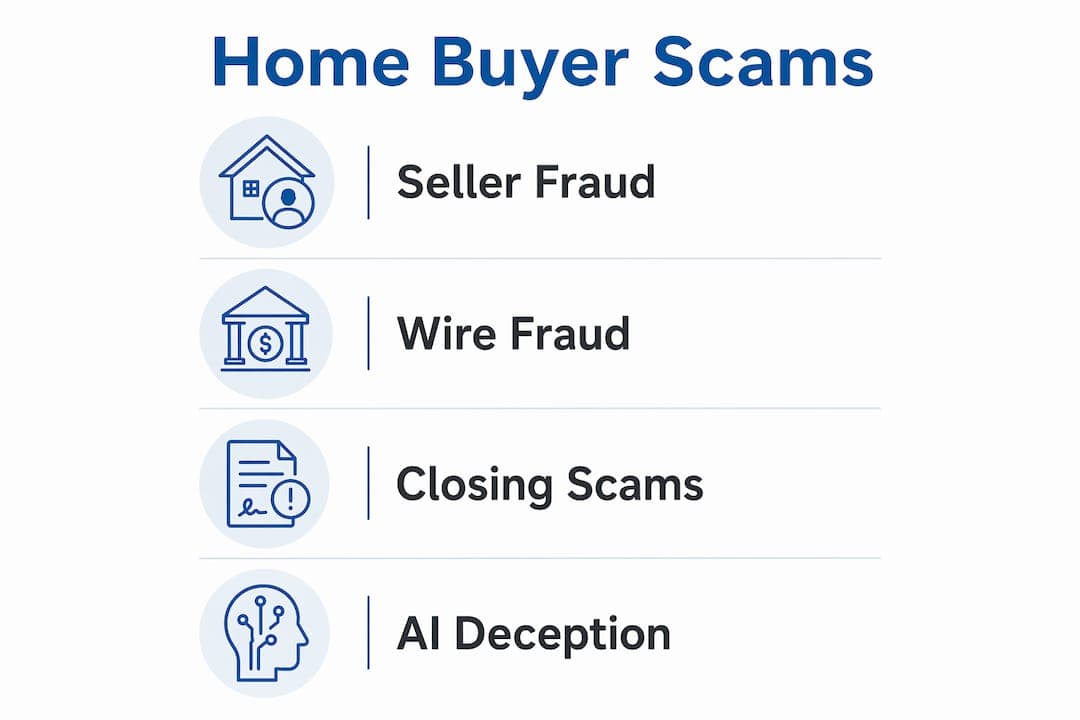
Home buyer fraud operates through three primary attack vectors: seller impersonation, wire fraud, and closing process manipulation.
Home buyer fraud operates through three primary attack vectors: seller impersonation, wire fraud, and closing process manipulation. Each one targets a different vulnerability in the transaction chain, and all three have grown more convincing with the help of AI tools.
Key Takeaways
- Scale of the problem
- The FBI recorded $275 million in real estate cyberfraud
- Most dangerous window
- Wire fraud and impersonation attacks peak in the days
- AI raises the stakes
- AI-generated emails and voice clones now mimic real agents
- Best prevention habit
- Always verify wire instructions by calling a trusted number
What are the most common types of home buyer scams?: Seller impersonation fraud
Seller impersonation fraud is exactly what it sounds like. A criminal poses as the legitimate property owner, typically targeting [vacant land and remote…
Seller impersonation fraud is exactly what it sounds like. A criminal poses as the legitimate property owner, typically targeting vacant land and remote properties where the real owner is unlikely to notice activity. The Texas Department of Insurance reports that these scams rely on forged documents, remote notaries, and digital signatures to push transactions through before anyone verifies identity. Over half of real estate professionals report impersonation attempts involving vacant land and remote closings. Experienced title professionals now treat certain seller scenarios as fraud until proven otherwise, requiring stricter identity verification for any remote or vacant property sale.
What are the most common types of home buyer scams?: Wire fraud during closing
- Wire instructions that arrive by email only, with no phone confirmation
- Last-minute changes to account numbers or routing details
- Pressure to send funds immediately without time to verify
- Requests to use a remote notary you did not select yourself
- Proceeds directed to an individual rather than a licensed title company
How does AI make scams in real estate harder to detect?
"Real estate transactions are attractive to scammers due to high value and complex workflows involving many trusted parties.
"Real estate transactions are attractive to scammers due to high value and complex workflows involving many trusted parties. AI enhances the realism of impersonations to a degree that traditional verification habits can no longer keep pace with." — NAR research on rising scam threats
How does AI make scams in real estate harder to detect?
Artificial intelligence has fundamentally changed the difficulty level of detecting home buyer fraud.
Artificial intelligence has fundamentally changed the difficulty level of detecting home buyer fraud. Real estate transactions are attractive to scammers because they involve high dollar amounts and complex workflows with many trusted parties. AI makes it possible to generate convincing email impersonations, voice clones, and even video calls that mimic real agents, attorneys, or title officers.
1 in 5 homeowners receives a fraudulent message before closing. That statistic means the average buyer has a real chance of encountering a scam attempt during a single transaction. AI-generated emails now replicate writing style, formatting, and even the sender's typical sign-off phrases, making them nearly indistinguishable from legitimate correspondence.
The psychological impact is significant. A phenomenon called "wire fraud fear" has emerged among buyers who delay or abandon transactions because they cannot confidently verify whether instructions are real. That hesitation costs time and sometimes deals. The answer is not to avoid wiring funds. The answer is to build a verification process that does not depend on email at all.
Traditional defenses like spam filters and antivirus software do not catch these attacks because the emails come from legitimately compromised accounts. Process changes, not technology alone, are what protect buyers. Calling a known number before any wire transfer is the single most reliable control available.

How to avoid home scams: practical steps for buyers
- Step 1 — Establish a verification protocol early. At your first meeting with your title company or attorney, confirm the exact phone number you will use to verify wire instructions Write it down. Never rely on contact information sent by email.
- Step 2 — Treat any change in wire instructions as a red flag. The strongest control against wire fraud is treating any post-update instruction with immediate suspicion Legitimate title companies do not change wire details at the last minute.
- Step 3 — Verify seller identity for vacant or remote properties. If you are buying land or a property where the seller is not local, require in-person identity verification or a notarized ID check through a licensed notary you select Remote notaries requested by the seller are a known fraud vector.
- Step 4 — Secure your email account. Enable two-factor authentication on every email account connected to your real estate transaction Criminals compromise buyer and agent email accounts to intercept communications and insert fake instructions.
- Step 5 — Use a licensed title company with a physical office. Direct proceeds should always flow through a licensed title company, not to an individual Any request to wire funds directly to a seller or a third party is a serious warning sign.
Where and how should you report suspected home buyer scams?
- Save all emails with full headers, not just the message body
- Screenshot any wire instructions, account numbers, and routing details
- Record timestamps for every communication related to the suspicious activity
- Note the exact dollar amount and destination account for any transfer made
- — FBI Internet Crime Complaint Center (IC3): File at ic3.gov. The FBI's recovery protocols require exact records including email headers and timestamps to initiate a freeze.
Key Takeaways
Home buyer fraud is a process problem, not just a technology problem. Verification habits built before closing day are the most reliable defense against wire fraud and impersonation scams.
Home buyer fraud is a process problem, not just a technology problem. Verification habits built before closing day are the most reliable defense against wire fraud and impersonation scams.
What I've learned watching real estate fraud evolve
— Eric
What I've learned watching real estate fraud evolve
The part that surprises most buyers is how little title insurance actually protects them from wire fraud.
The part that surprises most buyers is how little title insurance actually protects them from wire fraud. Title insurance covers ownership disputes and title defects. It does not cover money you wired to a criminal because your email was compromised. That gap is not widely understood, and it catches people off guard at the worst possible moment.
I've also noticed that buyers tend to over-trust the presence of a real estate agent or attorney in the transaction. Having professionals involved does not eliminate risk. Email compromise happens outside the title process entirely. A criminal can intercept communications between you and your agent without either of you knowing until the money is gone.
The buyers who avoid fraud are not necessarily more tech-savvy. They are more process-disciplined. They call before they wire. They write down phone numbers at the first meeting. They ask uncomfortable questions when something feels slightly off. That friction is not paranoia. It is the correct response to a market where legitimate cash buyers and fraudulent ones can look nearly identical on paper.
The most dangerous misconception I encounter is that scams only happen to people who are not paying attention. The FBI's data shows otherwise. Sophisticated, educated buyers lose hundreds of thousands of dollars to these schemes every year. The scams are that good. Your defense has to be equally deliberate.
How Housefastcashfl helps Florida sellers transact safely
Selling your home under pressure is stressful enough without worrying about whether the buyer on the other end is legitimate.
Selling your home under pressure is stressful enough without worrying about whether the buyer on the other end is legitimate.
Housefastcashfl operates as a verified Florida cash buyer, listed with Google and the BBB, with a transparent three-step process from initial inquiry to closing. Every offer is no-obligation, and the process does not involve email-only wire instructions or remote-only closings. You can verify the company's legitimacy before you ever accept an offer. For Florida homeowners who want a fast, documented, and fraud-resistant sale, Housefastcashfl provides cash offers within 24 hours and can close in as few as four days.
Free Cash Offer
Ready to sell your house for cash?
Tell us about your property. We'll come back within 24 hours with a fair, no-obligation cash offer — no commissions, no inspection drama, no closing-cost surprises.
- Licensed Florida cash buyer
- Close in 7-21 days, on your timeline
- Free, no-obligation cash offer
- We respond within 24 hours
Cash Buyers Network
Sources & References
External sources cited in this article. Verify current figures and rules directly with the issuing source — Florida real-estate data and program rules change quarterly.
From the Blog
Continue Reading
home-selling
Inheritance Property Options: Your 2026 Heir's Guide
Explore inheritance property options in 2026: sell, rent, or move in. Learn how each choice impacts your finances and tax obligations.
Read articlehome-selling
Pitfalls of Listing Inherited Homes: 2026 Guide
Discover the pitfalls of listing inherited homes in 2026. Learn key strategies to navigate probate and safeguard your estate's value.
Read articlehome-selling
Seller Financing Rental Property in Florida: 2026 Guide
Discover how seller financing rental property in Florida can unlock investment opportunities. Learn the benefits, requirements, and legal steps.
Read articlehome-selling
Role of Heirs in Property Sales: 2026 Guide
Discover the role of heirs in property sales. Learn when you can sell inherited property and avoid common probate mistakes.
Read articleFrequently Asked
Common Questions
What is the most common home buying scam?
+
Wire fraud is the most financially damaging scam targeting home buyers. Criminals compromise email accounts and send fake wire instructions that redirect closing funds to fraudulent accounts.
How do I know if a cash buyer is legitimate?
+
Legitimate cash buyers are verifiable through the Better Business Bureau, Google business listings, and state licensing databases. Housefastcashfl recommends checking buyer credentials before signing any agreement.
What should I do if I already wired money to a scammer?
+
Contact your bank's fraud department and file a complaint with the FBI IC3 at ic3.gov immediately. Speed is critical because the FBI's Recovery Asset Team can only freeze funds before they are moved or withdrawn.
Can title insurance protect me from wire fraud?
+
Title insurance does not cover wire fraud losses. It covers ownership and title defects, not funds lost due to email compromise or fraudulent payment instructions.
How does AI make real estate scams harder to detect?
+
AI generates emails, voice messages, and even video calls that closely mimic real agents and title officers. NAR research confirms that AI-assisted impersonation during closing windows has made traditional email-based verification unreliable.