
What Is a No-Obligation Offer? a Homeowner's Guide
Discover what is a no-obligation offer and learn how it empowers homeowners in real estate decisions. Gain clarity without commitment!
What is a no-obligation offer in real estate?
A no-obligation offer is defined by 2025–2026 industry standards as a proposal without binding commitments for either party.
A no-obligation offer is defined by 2025–2026 industry standards as a proposal without binding commitments for either party. That definition matters because it separates a casual expression of interest from a legally enforceable contract. Until you sign a purchase agreement, nothing is final.
In real estate, this concept shows up most clearly in cash offers. A buyer submits a figure based on your property's condition and local market data. You review it. You decide. No pressure, no penalties, no fees. No-obligation cash offers are especially common among homeowners facing foreclosure, inherited properties, or homes in poor condition that would struggle on the traditional market.
The term "non-binding offer" is the standard industry phrase for the same concept. Both terms describe a communication of intent. Only a definitive contract, signed after due diligence, binds the parties. Knowing this distinction protects you from pressure tactics that blur the line between an offer and a commitment.

Key Takeaways
- Offer price
- Does it reflect current Florida market values and your
- Closing timeline
- Is the proposed closing date realistic for your situation?
- Fees and costs
- Are there zero seller fees, commissions, or closing costs?
- As-is terms
- Does the buyer accept the property without requiring
What are the benefits of no-obligation offers for homeowners?
- — No repair costs. Cash buyers purchase homes as-is. You do not need to fix the roof, repaint walls, or replace appliances before the sale.
- — No agent commissions. Traditional sales typically involve agent fees. No-obligation cash offers carry no fees or commissions for the seller.
- — Faster closing. No-obligation cash offers close in 7–14 days, compared to the months a traditional listing can take. That speed matters when you are facing foreclosure or a sudden relocation.
- — No showings or listings. You skip the open houses, the staging, and the weeks of strangers walking through your home.
- — Reduced anxiety. Psychology research shows that no-commitment offers increase trust and reduce the fear of making a wrong financial decision. Removing pressure at the start builds confidence throughout the process.
How does a no-obligation offer work legally and practically?
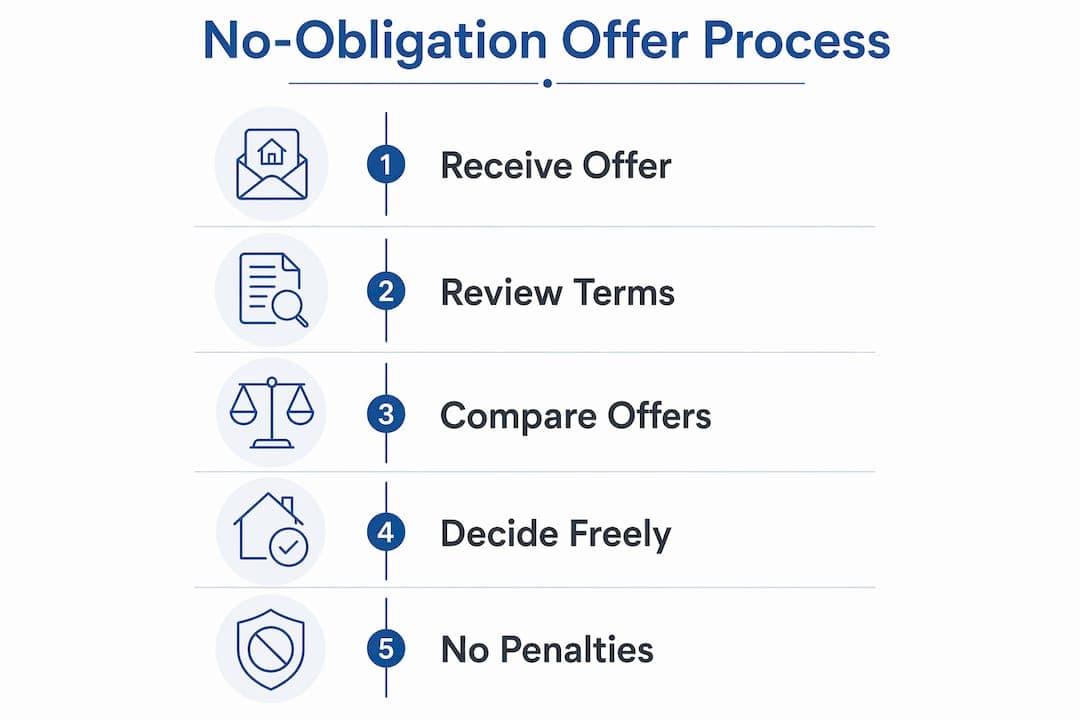
- Step 1 — Offer submission. The buyer presents a written cash offer based on your property's condition, location, and current market values.
- Step 2 — Review period. You examine the offer terms, including price, closing timeline, and any conditions attached.
- Negotiation or response. You can accept, counter, or decline — No action carries a penalty.
- Contract execution. If you accept, both parties sign a purchase agreement — This is the moment legal obligations begin.
- Due diligence and closing. The buyer completes inspections or title checks — Closing follows within the agreed timeline.
What should homeowners watch out for when receiving no-obligation offers?
- — Exclusivity clauses. Some offers include language preventing you from speaking to other buyers for a set period. That is a binding restriction, regardless of the "no obligation" label.
- — Confidentiality provisions. Agreements requiring you to keep offer terms private can be legally enforceable, even in otherwise non-binding documents.
- — Hidden fees. Legitimate no-obligation offers carry no costs for the seller. Any mention of processing fees, evaluation charges, or administrative costs is a warning sign.
- — Vague or missing disclaimers. Transparent offers use clear language stating the proposal is non-binding. Vague terms leave room for dispute.
- — High-pressure timelines. A buyer who demands a response within hours is applying pressure that contradicts the spirit of a no-obligation offer.
How to request and evaluate a no-obligation cash offer on your home
- Step 1 — Submit your property details. Provide the address, a brief description of the property's condition, and any relevant circumstances such as inherited ownership, water damage, or an active mortgage.
- Step 2 — Receive your offer. Buyers use market data, property condition, and repair estimates to generate a fair cash figure Housefastcashfl delivers offers within 24 hours for Florida homeowners.
- Step 3 — Evaluate and decide. Compare the offer against your financial needs and timeline You are under no obligation to respond immediately or at all.
Key Takeaways
A no-obligation offer gives homeowners the freedom to evaluate a cash proposal without legal or financial risk, making it one of the most seller-friendly tools in real estate.
A no-obligation offer gives homeowners the freedom to evaluate a cash proposal without legal or financial risk, making it one of the most seller-friendly tools in real estate.

Housefastcashfl's no-obligation cash offers for Florida homeowners
Florida homeowners dealing with foreclosure, inherited properties, storm damage, or a fast-moving life change have a direct path to a fair cash offer through Housefastcashfl.
Florida homeowners dealing with foreclosure, inherited properties, storm damage, or a fast-moving life change have a direct path to a fair cash offer through Housefastcashfl.
Housefastcashfl delivers cash offers within 24 hours with no repairs required, no agent commissions, and no pressure to accept. The process starts with your property details and ends with a clear, written offer you are free to accept, counter, or decline. Closing timelines run as short as four days. If you want to understand whether a cash sale fits your situation, you can also review how home buying companies work before making any decision. No commitment required at any stage.
Free Cash Offer
Ready to sell your house for cash?
Tell us about your property. We'll come back within 24 hours with a fair, no-obligation cash offer — no commissions, no inspection drama, no closing-cost surprises.
- Licensed Florida cash buyer
- Close in 7-21 days, on your timeline
- Free, no-obligation cash offer
- We respond within 24 hours
Cash Buyers Network
Sources & References
External sources cited in this article. Verify current figures and rules directly with the issuing source — Florida real-estate data and program rules change quarterly.
From the Blog
Continue Reading
home-selling
Inheritance Property Options: Your 2026 Heir's Guide
Explore inheritance property options in 2026: sell, rent, or move in. Learn how each choice impacts your finances and tax obligations.
Read articlehome-selling
Pitfalls of Listing Inherited Homes: 2026 Guide
Discover the pitfalls of listing inherited homes in 2026. Learn key strategies to navigate probate and safeguard your estate's value.
Read articlehome-selling
Seller Financing Rental Property in Florida: 2026 Guide
Discover how seller financing rental property in Florida can unlock investment opportunities. Learn the benefits, requirements, and legal steps.
Read articlehome-selling
Role of Heirs in Property Sales: 2026 Guide
Discover the role of heirs in property sales. Learn when you can sell inherited property and avoid common probate mistakes.
Read articleFrequently Asked
Common Questions
What does "no obligation" mean in a real estate offer?
+
A no-obligation offer means the recipient has no legal duty to accept, respond, or proceed. No binding contract exists until both parties sign a formal purchase agreement.
Are no-obligation cash offers legitimate?
+
Yes, when made by verified buyers. Legitimate offers carry no seller fees, use clear non-binding language, and come from buyers with verifiable business records and closed transaction histories.
How long does a no-obligation offer stay valid?
+
Most no-obligation cash offers expire within 24–72 hours, though terms vary by buyer. After expiration, the buyer may revise the figure based on updated market conditions.
Can a no-obligation offer become legally binding?
+
Yes, if it contains exclusivity, confidentiality, or other specific clauses. Courts have ruled that certain provisions within otherwise non-binding offers can become enforceable. Always read the full document before signing anything.
What is the difference between a no-obligation offer and a binding contract?
+
A no-obligation offer is a proposal with no legal consequences for declining. A binding contract, signed by both parties after acceptance, creates enforceable obligations including closing timelines, deposit terms, and penalties for default.