
Why Sell in Inherited Situations: Your 2026 Guide
Discover why sell in inherited situations is a smart 2026 move. Maximize profits, minimize stress, and understand tax benefits today!
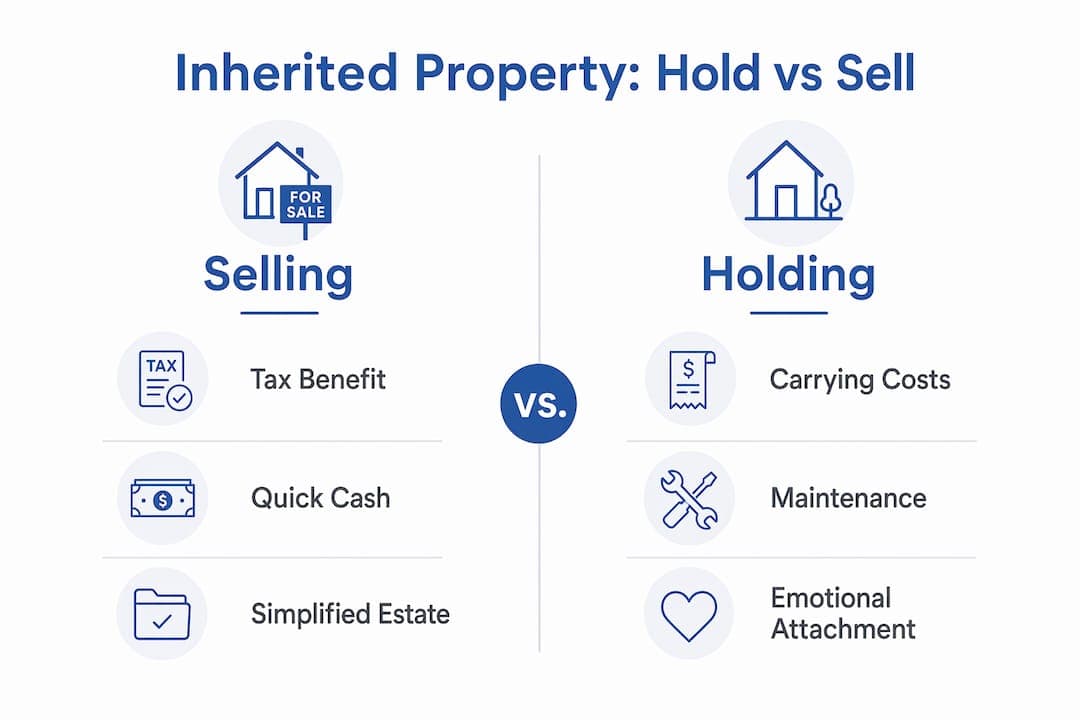
Why sell in inherited situations: the tax basis advantage
- — Date-of-death FMV is the standard basis, but executors can elect an alternate valuation date six months later if the estate's value declined.
- — Taxable gains above the stepped-up basis must be reported on Schedule D and Form 8949 when you file your federal return.
- — Long-term vs. short-term rates do not apply the same way to inherited property. The IRS treats inherited assets as long-term regardless of how long you hold them before selling.
- — State taxes in Florida add no income tax burden, which makes Florida-inherited properties especially favorable for a quick sale.
Key Takeaways
- Property taxes (Florida
- $2,500 – $4,500
- Homeowner's insurance
- $2,000 – $3,500
- Utilities (vacant home)
- $1,200 – $2,400
- Routine maintenance
- $4,000 – $8,800
How carrying costs quietly erode your net proceeds
Every month you hold an inherited property, the clock runs against you financially. [Carrying…
Every month you hold an inherited property, the clock runs against you financially. Carrying costs including property taxes, homeowner's insurance, utilities, HOA fees, and routine maintenance can total $3,000 to $6,000 or more over just six months. That figure does not account for deferred maintenance or unexpected repairs.
The broader picture is even sharper. A home can cost $21,400 annually beyond any mortgage obligation, with maintenance alone averaging $8,800 per year. For heirs who did not budget for these expenses, the financial pressure builds fast.
Probate timelines in Florida typically run three to twelve months, depending on estate complexity. During that window, every one of these costs accumulates whether or not you intend to sell. Deferred maintenance compounds the problem. A roof that needed attention six months ago now requires full replacement, and that cost comes directly out of your net proceeds.
Pro Tip: Before deciding to hold or sell, calculate your true net proceeds by subtracting projected carrying costs for your expected hold period from the current market value. Many heirs discover that a slightly lower offer today outperforms a higher price six months from now.

Why selling simplifies estate settlement among multiple heirs
Joint ownership of inherited property is one of the most common sources of family conflict in estate settlements.
Joint ownership of inherited property is one of the most common sources of family conflict in estate settlements. Dividing cash proceeds is straightforward, while shared property ownership creates ongoing friction around maintenance decisions, usage scheduling, and eventual sale timing.
Consider a scenario where three siblings inherit a Tampa home equally. One wants to rent it, one wants to sell immediately, and one wants to move in. No single heir controls the decision without unanimous agreement or a court partition action. That legal process is expensive and damages family relationships. Selling converts the asset into cash that divides cleanly and closes the chapter.
Selling vs. keeping for multiple heirs:
Beyond the financial math, there is a real emotional benefit to closure. Selling an inherited home gives heirs the space to grieve and move forward without the property serving as a recurring source of disagreement. That psychological relief is a legitimate reason to sell, and experienced estate attorneys in Florida consistently cite it as a factor heirs underestimate until they are deep in a co-ownership dispute.
Liquidity, diversification, and your broader financial goals
- — High-interest debt elimination. Sale proceeds applied to credit card balances or personal loans at 20%+ APR deliver an immediate, guaranteed return.
- — Retirement funding. Heirs in their 50s and 60s often use proceeds to max out IRA or 401(k) contributions, capturing tax-deferred growth.
- — Portfolio diversification. A single Florida property represents concentrated geographic and market risk. Cash can spread across asset classes.
- — Urgent financial needs. Medical bills, business capital, or education costs are immediate priorities that a property cannot address without a sale.
Practical tips for timing and executing the sale
- Step 1 — Obtain a professional appraisal at or near the date of death to establish and document your stepped-up basis This protects you at tax time and sets a realistic listing price.
- Step 2 — Collect basis documentation from the executor, specifically Schedule A to Form 8971, as recommended by the IRS for accurate tax reporting.
- Engage a real estate agent with specific estate sale experience — Standard residential agents often lack familiarity with probate timelines, executor authority, and title clearance requirements.
- Step 4 — Evaluate cash offers seriously. A quick cash sale eliminates showings, contingencies, and financing delays that extend your carrying cost exposure.
- Step 5 — Calculate net proceeds accurately. Subtract agent commissions, closing costs, and projected carrying costs from any offer before comparing options.
Key takeaways
Selling inherited property quickly maximizes tax advantages, minimizes carrying costs, and converts a complex shared asset into clean, liquid proceeds.
Selling inherited property quickly maximizes tax advantages, minimizes carrying costs, and converts a complex shared asset into clean, liquid proceeds.
What I've learned after years of watching heirs delay
— Eric
What I've learned after years of watching heirs delay
I have seen the same pattern repeat more times than I can count. An heir inherits a property, feels the emotional weight of the decision, and waits.
I have seen the same pattern repeat more times than I can count. An heir inherits a property, feels the emotional weight of the decision, and waits. Six months later, they have paid $8,000 in carrying costs, discovered a plumbing issue, and watched two siblings stop speaking to each other over a disagreement about whether to rent or sell. The financial outcome is worse. The family relationship is worse. And the decision they eventually make is the same one they could have made on day one.
The emotional pull to hold onto a parent's home is real and completely understandable. That house holds memories. Selling it can feel like a second loss. But the most meaningful way to honor a loved one's legacy is through sound stewardship of what they left behind, not through a property that becomes a source of stress and expense.
The heirs who come out ahead financially and emotionally are the ones who get professional advice early, understand the tax window the stepped-up basis creates, and make a clear-eyed decision within the first 90 days. They do not rush out of grief. They act because they understand the numbers and respect their own time and peace of mind.
If you are holding onto an inherited property because the decision feels too big, that feeling is valid. But it should not be the reason you delay. Get the appraisal. Talk to a tax advisor. Understand what holding actually costs you. Then make the decision from a position of knowledge, not avoidance.
How Housefastcashfl can help you sell an inherited home fast
If you are dealing with an inherited property in Florida and want to skip the months of carrying costs, probate delays, and repair negotiations, Housefastcashfl offers a direct path forward.
If you are dealing with an inherited property in Florida and want to skip the months of carrying costs, probate delays, and repair negotiations, Housefastcashfl offers a direct path forward.
Housefastcashfl provides fast cash offers for inherited homes across Florida, with no repairs required, no agent commissions, and closing timelines as short as four days. The team understands estate sale complexities, including probate clearance and executor authority, so you are not educating a buyer on how the process works. If you want to verify that you are working with a legitimate buyer, Housefastcashfl is verified through Google and BBB. Reach out for a no-obligation cash offer and know your numbers before you commit to anything.

Side-by-side comparison
| Selling | Keeping | |
|---|---|---|
| Asset division | Clean cash split | Requires ongoing co-ownership agreement |
| Decision-making | One-time transaction | Continuous shared decisions |
| Maintenance responsibility | Eliminated at closing | Shared indefinitely |
| Conflict risk | Low | High over time |
| Liquidity | Immediate | Locked in property |
Free Cash Offer
Ready to sell your house for cash?
Tell us about your property. We'll come back within 24 hours with a fair, no-obligation cash offer — no commissions, no inspection drama, no closing-cost surprises.
- Licensed Florida cash buyer
- Close in 7-21 days, on your timeline
- Free, no-obligation cash offer
- We respond within 24 hours
Cash Buyers Network
Sources & References
External sources cited in this article. Verify current figures and rules directly with the issuing source — Florida real-estate data and program rules change quarterly.
From the Blog
Continue Reading
home-selling
Inheritance Property Options: Your 2026 Heir's Guide
Explore inheritance property options in 2026: sell, rent, or move in. Learn how each choice impacts your finances and tax obligations.
Read articlehome-selling
Pitfalls of Listing Inherited Homes: 2026 Guide
Discover the pitfalls of listing inherited homes in 2026. Learn key strategies to navigate probate and safeguard your estate's value.
Read articlehome-selling
Seller Financing Rental Property in Florida: 2026 Guide
Discover how seller financing rental property in Florida can unlock investment opportunities. Learn the benefits, requirements, and legal steps.
Read articlehome-selling
Role of Heirs in Property Sales: 2026 Guide
Discover the role of heirs in property sales. Learn when you can sell inherited property and avoid common probate mistakes.
Read articleFrequently Asked
Common Questions
What is the stepped-up basis and why does it matter for heirs?
+
The stepped-up basis resets your tax cost to the property's fair market value on the date of the decedent's death, per IRS rules. This eliminates all pre-inheritance appreciation from your capital gains calculation, often reducing your tax liability to near zero on a quick sale.
How much do carrying costs reduce inherited property proceeds?
+
Carrying costs including taxes, insurance, utilities, and maintenance can total $3,000 to $6,000 over six months, and annual ownership costs can reach $21,400 or more. These expenses directly reduce your net proceeds the longer you hold the property before selling.
Can heirs sell an inherited property before probate is complete?
+
In most cases, the property cannot be sold until the executor has legal authority to transfer title, which requires probate court approval. Florida's summary administration process can accelerate this for smaller estates, but standard probate typically takes three to twelve months.
Is selling better than renting an inherited property?
+
Selling is typically the stronger financial choice for heirs who do not want active landlord responsibilities. Net rental yields after expenses, vacancy, and management fees often fall below 4%, while a sale delivers immediate liquidity that can be deployed into higher-return or lower-risk assets.
What documents do heirs need before selling inherited property?
+
Heirs should obtain Schedule A to Form 8971 from the executor to confirm the official stepped-up basis, along with the death certificate, probate court order, and any existing title documents. Accurate basis documentation protects against IRS compliance penalties at the time of sale.