
Why Sell Inherited Property in 2026: a Smart Heir's Guide
Discover why selling inherited property in 2026 can maximize your financial benefits. Learn key tax strategies and make informed decisions!
How does the federal step-up in basis rule affect selling inherited property in 2026?
- — Order a date-of-death appraisal immediately. Appraisal costs range from $300 to $600 for a typical single-family home and provide the IRS documentation needed to support your stepped-up basis.
- — Consult a CPA before listing. The IRS can dispute your basis if it is not properly documented, turning a tax-free sale into a costly audit.
- — Track all post-inheritance improvements. Any money you spend on repairs or upgrades after the date of death adds to your basis and further reduces taxable gain.
Key Takeaways
- Step-up in basis advantage
- Your tax basis resets to fair market value at death
- Carrying cost pressure
- Holding an inherited property costs $10,000–$25,000 per
- Probate timing
- Probate can delay your authority to sell by 4 to 12 months
- Long-term gains treatment
- All inherited property sales qualify for long-term capital
What financial and practical reasons motivate heirs to sell quickly?
Tax savings are compelling, but the financial case for selling goes well beyond the IRS. [Carrying costs for inherited…
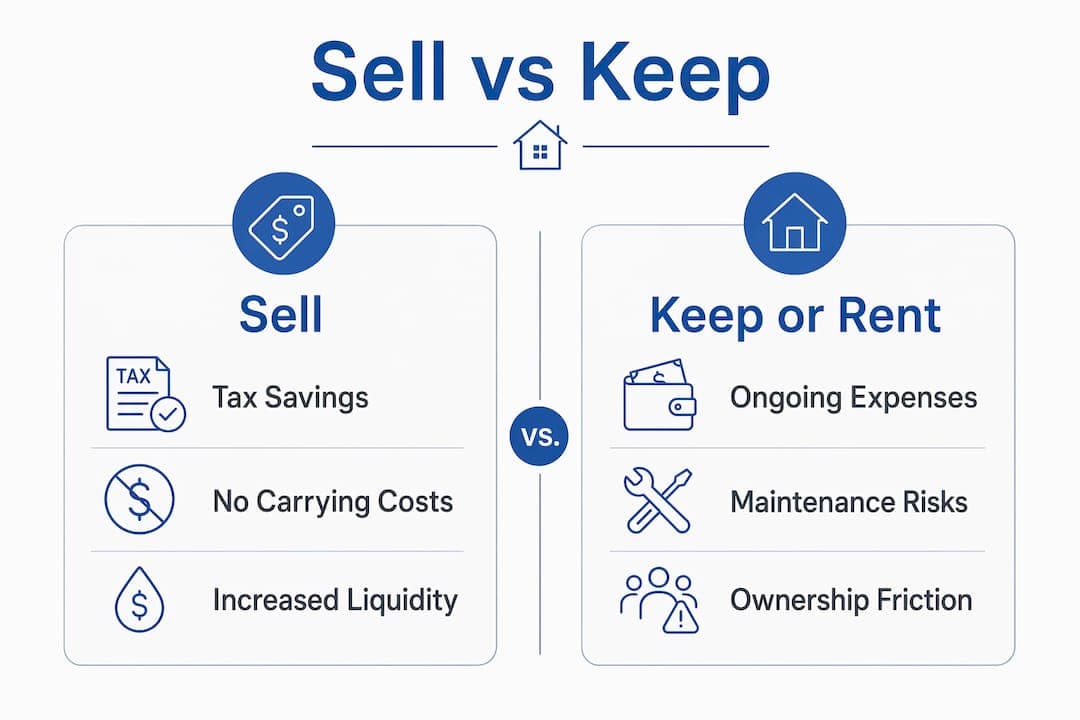
Tax savings are compelling, but the financial case for selling goes well beyond the IRS. Carrying costs for inherited properties often range from $10,000 to $25,000 per year, covering property taxes, homeowner's insurance, maintenance, utilities, and any existing mortgage payments. That is a real monthly cash drain on an asset you did not budget for and may not want to manage.
The comparison between selling and holding looks like this:
Multi-heir ownership creates its own friction. When two or more siblings inherit a property jointly, unanimous agreement is often required on listing price, timing, and sale terms. One holdout can stall the entire process for months. Professional mediation or a partition lawsuit may become necessary, both of which cost money and damage family relationships.
Heirs also frequently underestimate what it takes to manage a property they did not choose to own. Deferred maintenance, outdated systems, and code compliance issues can surface quickly. A roof that needs replacement, an HVAC system at end of life, or a foundation issue can easily cost $20,000 to $50,000 before the home is market-ready.
The liquidity argument is equally strong. Selling converts a single illiquid asset into cash you can deploy across stocks, bonds, a down payment on your own home, or debt reduction. Portfolio concentration in one inherited property, especially one you do not live in, carries more risk than most heirs recognize.
Pro Tip: Before deciding to rent the property instead of selling, calculate the true net yield after taxes, insurance, maintenance, and property management fees. Most heirs find the [actual rental return](https://housefastcashfl.com/blog/quick-sale-scenarios-for-florida-homeowners-fast-cash) is far lower than the headline rent figure suggests.

What legal and probate considerations affect the timing of selling an inherited home?
- — Revocable living trust: Property transfers immediately to the named beneficiary. No court involvement. You can list and sell within weeks of death.
- — Transfer-on-death deed (Lady Bird deed in Florida): Ownership transfers automatically at death. Probate is bypassed entirely.
- — Probate estate: The court appoints an executor or personal representative, validates the will, resolves creditor claims, and then authorizes the sale. This is the slowest path.
- — Intestate (no will): Florida's intestacy statutes determine heirs, which can add additional court time and complexity.
What practical selling options exist for heirs wanting a fast, straightforward sale?
- Step 1 — Confirm legal authority to sell by consulting a Florida probate attorney.
- Step 2 — Order a date-of-death appraisal to establish your stepped-up basis.
- Step 3 — Conduct a title search to identify liens, mortgages, or encumbrances.
- Step 4 — Decide on your sale method based on your timeline, property condition, and financial goals.
- Step 5 — Gather all required disclosures, including the Florida Seller's Disclosure form.
Key takeaways
Selling inherited property in 2026 is most financially advantageous when done promptly after inheritance, using the step-up in basis under IRC §1014 to minimize…
Selling inherited property in 2026 is most financially advantageous when done promptly after inheritance, using the step-up in basis under IRC §1014 to minimize capital gains taxes while avoiding escalating carrying costs and legal delays.

What I've learned from watching heirs make this decision under pressure
— Eric
What I've learned from watching heirs make this decision under pressure
I have seen heirs on both ends of this decision, and the ones who struggle most share one pattern: they let grief drive the financial timeline.
I have seen heirs on both ends of this decision, and the ones who struggle most share one pattern: they let grief drive the financial timeline. Holding onto a property because selling feels like letting go of a parent is completely understandable. It is also expensive. Every month of delay after the stepped-up basis date is a month of appreciation that becomes taxable gain.
That said, the 90-day window after inheritance is real. Financial advisors consistently recommend using that period to inventory the property, consult a CPA, and get a probate attorney engaged, not to rush a sale, but to make a clear-eyed decision with full information. The worst outcomes I have seen come from heirs who either sold in week one without understanding their tax position, or waited two years while carrying costs and family tension compounded.
The practical advice I give every time: hire a CPA and an estate attorney before you hire a real estate agent. The tax and legal picture must be clear before the marketing picture matters. A good CPA will tell you exactly what your stepped-up basis is, what your net proceeds will look like after taxes, and whether a short hold period changes the math meaningfully. In most cases, it does not change it enough to justify the carrying costs.
Family communication is the other piece most articles skip. If you have siblings or co-heirs, get everyone in the same room, or on the same call, before any decisions are made. Disagreements that surface after an offer arrives are far harder to resolve than disagreements addressed upfront. A real estate attorney or mediator can facilitate that conversation if emotions are running high.
The step-up in basis is a genuine, legal, and significant financial gift. Use it deliberately.
How Housefastcashfl helps heirs sell inherited Florida property fast
If you are an heir in Florida dealing with probate delays, deferred maintenance, or a property you simply cannot afford to hold, Housefastcashfl provides a direct path to a fast, fair cash offer.
If you are an heir in Florida dealing with probate delays, deferred maintenance, or a property you simply cannot afford to hold, Housefastcashfl provides a direct path to a fast, fair cash offer.
Housefastcashfl delivers no-obligation cash offers within 24 hours, with closing timelines as short as four days. No repairs, no showings, no agent commissions. The process works regardless of property condition or probate status, and every offer is transparent and backed by a BBB-verified operation. For heirs who need liquidity now and want to avoid the cost and complexity of a traditional listing, get a cash offer today and close on your schedule. You can also review how home buying companies work to verify the process before you commit.
Side-by-side comparison
| Sell | Keep or Rent | |
|---|---|---|
| Annual carrying costs | Eliminated at closing | $10,000–$25,000 per year |
| Capital gains exposure | Minimized near date of death | Grows with each year of appreciation |
| Property condition risk | Transferred to buyer | Ongoing liability for repairs |
| Liquidity | Immediate cash proceeds | Locked in illiquid asset |
| Family conflict risk | Resolved at sale | Compounds with co-ownership |
Free Cash Offer
Ready to sell your house for cash?
Tell us about your property. We'll come back within 24 hours with a fair, no-obligation cash offer — no commissions, no inspection drama, no closing-cost surprises.
- Licensed Florida cash buyer
- Close in 7-21 days, on your timeline
- Free, no-obligation cash offer
- We respond within 24 hours
Cash Buyers Network
Sources & References
External sources cited in this article. Verify current figures and rules directly with the issuing source — Florida real-estate data and program rules change quarterly.
From the Blog
Continue Reading
home-selling
Inheritance Property Options: Your 2026 Heir's Guide
Explore inheritance property options in 2026: sell, rent, or move in. Learn how each choice impacts your finances and tax obligations.
Read articlehome-selling
Pitfalls of Listing Inherited Homes: 2026 Guide
Discover the pitfalls of listing inherited homes in 2026. Learn key strategies to navigate probate and safeguard your estate's value.
Read articlehome-selling
Seller Financing Rental Property in Florida: 2026 Guide
Discover how seller financing rental property in Florida can unlock investment opportunities. Learn the benefits, requirements, and legal steps.
Read articlehome-selling
Role of Heirs in Property Sales: 2026 Guide
Discover the role of heirs in property sales. Learn when you can sell inherited property and avoid common probate mistakes.
Read articleFrequently Asked
Common Questions
What is the step-up in basis and why does it matter for heirs?
+
The step-up in basis resets your tax cost to the property's fair market value at the date of the original owner's death, under IRC §1014. This means you owe capital gains tax only on appreciation that occurs after you inherit the property, not on decades of prior growth.
Should I sell inherited real estate before or after probate?
+
You generally cannot sell until probate is complete and an executor has court authorization, a process that takes four to twelve months in Florida. Properties held in a revocable trust or covered by a Lady Bird deed bypass probate entirely and can be sold much faster.
What are the main financial risks of holding an inherited property?
+
Carrying costs of $10,000 to $25,000 per year, combined with growing capital gains exposure as the property appreciates beyond the stepped-up basis, make long-term holding costly for most heirs.
How fast can an inherited property be sold for cash in Florida?
+
As-is cash sales through a direct buyer can close in as little as 7 to 14 days, making them the fastest option for heirs who need immediate liquidity or want to avoid repair costs and traditional listing timelines.
Do I need an appraisal before selling an inherited home?
+
Yes. A date-of-death appraisal, typically costing $300 to $600, documents your stepped-up basis for the IRS and protects you from disputes. It also gives executors legal cover when presenting the sale price to probate courts and co-heirs.